What Are Humans For?
If thinking can be automated and production optimised, the question underneath the anxiety is not what AI can do. It is what we thought we were.
Ahmed Abaza opens his TEDx talk by reading a diary entry. Before 5:40am, a contract closed with a manufacturing plant in Nairobi at ten percent lower cost. By 7:30, a hundred and fifty interviews conducted and five offers sent. At 10:27, three minutes to reconcile the numbers and build a three-year strategy before walking into a board meeting and winning consensus on every point.
The entry ends: "Dear diary, I'm always baffled by how those pesky humans think they're better than us."
It is an imagined AI agent's diary, a few years out. And his framing of the reaction in the room is the sharpest part: this confusion arrives at the start of every technological era. When cars appeared, people could not see them replacing horses, because they were reasoning from a world with no roads, no crosswalks, no traffic lights. Within a few short years the world reorganised itself and the horses were gone.
"The problem," he says, "is in this scenario, we are the horses."
The temple, and who built it
Rather than argue about capability timelines, Abaza does something more useful: he asks where our sense of human worth actually came from. He traces it to three ideas we have been repeating for centuries.
Descartes gave us "I think, therefore I am" — the whole of the human experience folded into the mind. Machiavelli gave us appearance as identity: everyone sees what you appear to be, few feel who you are. Advice written for princes, Abaza notes, that now lives as an app in your pocket. And Adam Smith, walking through a pin factory, worked out that ten workers each doing one fragment of the task could vastly outproduce one worker making whole pins — and the division of labour became the engine of the modern economy, and then quietly became our identity.
You are your intelligence. You are the image you project. You are your role on the conveyor belt. Ask anyone what they are and they will tell you what they do.
Those three ideas are the pillars of what he calls the temple of human value. And a dragon is now walking toward it.
Which dragon
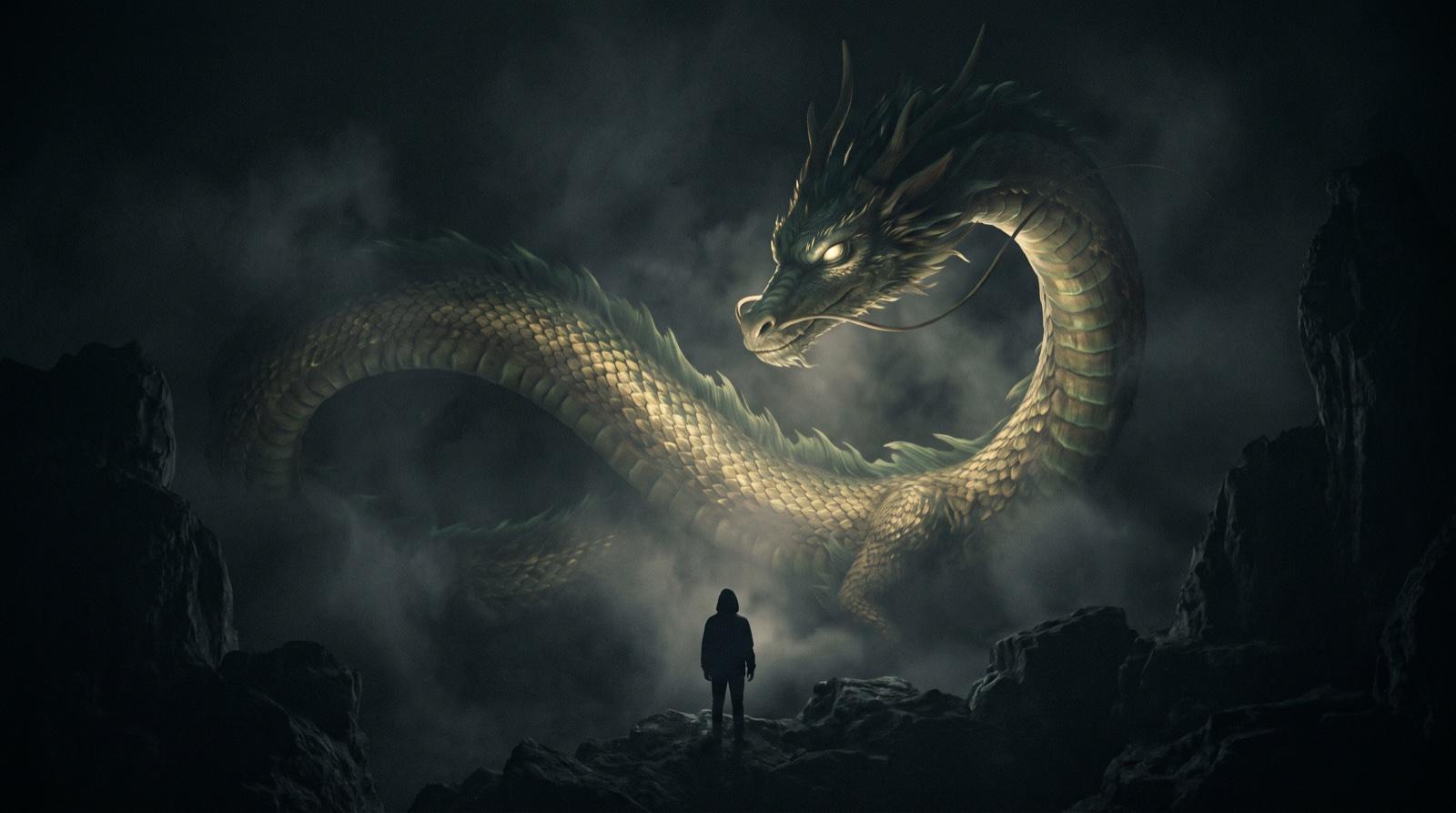
Here the talk turns. In Western stories, the dragon exists to be killed — Saint George rides out, kills it, takes the treasure it guarded. In Eastern traditions, the hero never kills the dragon. The dragon is the means by which the hero transforms.
AI, Abaza argues, is our Eastern dragon. Not a crisis but a mirror, and the reflection asks an uncomfortable question: if you are not your intelligence, not your productivity, not your status, then who are you?
He tells the old story of the banker and the fisherman — the banker mapping out the enterprise, the IPO, the eventual retirement to a small village to fish and be with family, and the fisherman pointing out that this is precisely what he is doing today. Both men are right. They simply locate their value in different places. And Erich Fromm supplies the warning underneath it: we traded a life of being for a life of having, and the more you define yourself by what you have, the more terrified you become of losing it.
The part that lands hardest
Abaza describes seeing his daughter for the first time. She had produced nothing. Achieved nothing. By every metric available she was, in his word, worthless — and simultaneously the most precious thing he had ever seen.
Before we can do anything, we are already valuable. Nobody asks an infant what they have accomplished. Then somewhere along the way the value transfers to the grades, the credentials, the wealth, the title. We attached our worth to numbers, and something is now coming that will be better than all of us at producing those numbers.
What he is actually proposing
Not a world without work. He is explicit about that. A world beyond work as the primary source of identity — value from presence rather than production, from growth rather than efficiency, from what we become rather than what we do.
His most practical suggestion is also the least sentimental: bring back the polymath. If narrow function is exactly what automates first, then the person who ranges across fields is not being inefficient. They are doing the thing that does not compress.
That rhymes with something Sol Rashidi argued from an entirely different direction — that cross-disciplinary strength is where insight lives and where models are weakest. One arrives at it through corporate practice, the other through philosophy. They meet in the same place.
Intelligence and productivity, Abaza says, were never the summit of being human. They were only the parts we could measure. Benchmark yourself on those and a machine will always rank higher. That may say less about us than about what we chose to count.
He closes with a line from Imam Ali ibn Abi Talib, written more than a thousand years ago: you believe you are a mere speck in the cosmos, yet the cosmos itself is folded within you.